A colour palette panel that lives inside After Effects.
Pick a base colour, choose a harmony, apply the palette across selected layers, then export it as .ase or hand it to Figma. No switching to a browser, no copying hex codes by hand, no losing the palette when the project closes.
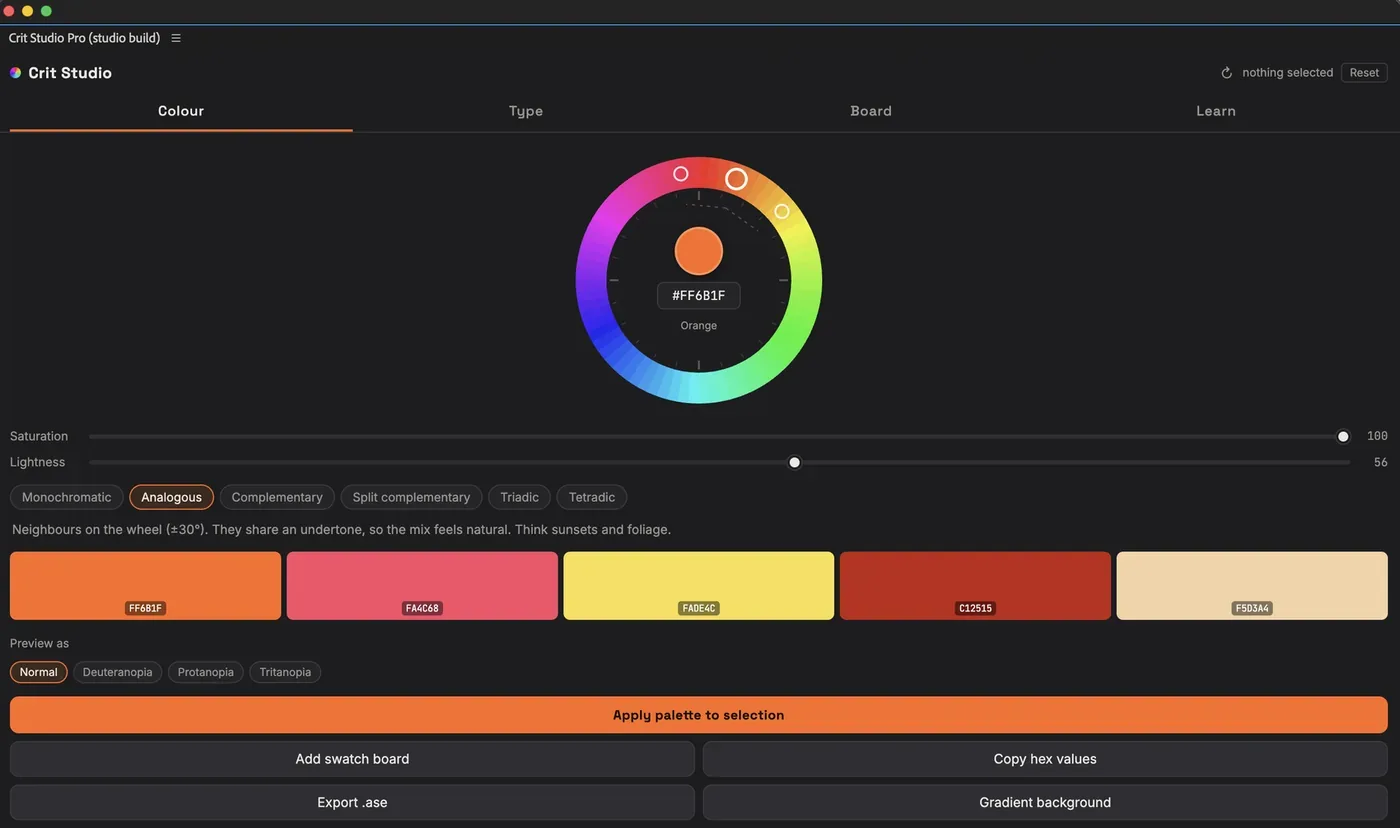
Analogous harmony from a chosen base, with the applied swatch row
Try the colour engine
The same harmony rules the panel uses, running here in the page.
Click a swatch to copy its hex.
What this is. The harmony maths and the colour blindness preview, nothing else. The hex values never change when you switch vision types — that is the point: the same palette, seen differently. The panel does the rest: applying a palette across selected layers, .ase export, the swatch board, and sending colours to Figma.
What it does
Four tabs. Colour is the one you will live in.
Colour
A wheel, saturation and lightness, six harmony rules, and the resulting swatches with their hex values.
Type
Pair a display and a text face, and keep the pairing with the palette rather than in a separate note.
Board
Drop a swatch board into the comp so the palette is visible in the timeline, not only in the panel.
Learn
Short notes on why a harmony behaves the way it does, written for students who already know the words.
What the panel can do with a palette once you have one
Specifics
The things people ask before installing.
Harmonies and checks
Six harmony rules from a single base colour: monochromatic, analogous, complementary, split complementary, triadic and tetradic. Every palette can be previewed as deuteranopia, protanopia and tritanopia, so a palette that only works for trichromatic vision fails in the panel rather than in the crit.
from a stillDrop in a film frame and pull a palette out of it
Getting the palette out
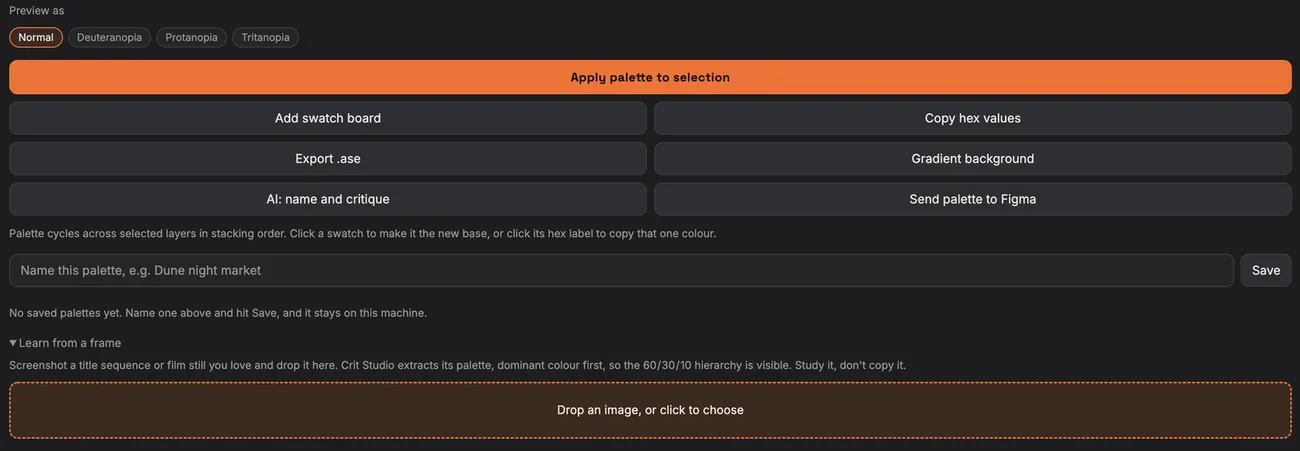
Apply the palette straight to selected layers, drop a swatch board into the comp, copy the hex list, export .ase for the rest of Adobe, build a gradient background, or send the palette to Figma where CRIT Bridge turns it into paint styles.
in AEApply to selection, swatch board, gradient background
files.ase, hex list
to FigmaPalette becomes paint styles via CRIT Bridge
The AI layer
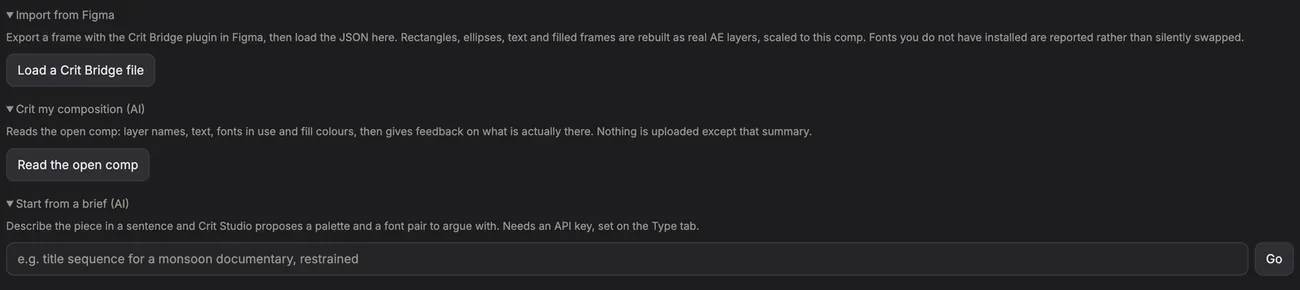
The panel can name a palette, critique it, read your open composition and comment on what is actually in it, or start a palette from a written brief. These features need an API key. In the student build it is your own key; in the studio build the layer is configured and managed for you.
readsThe open comp, a written brief, an imported CRIT Bridge file
needsYour own API key on the student build
privacySaved palettes stay on that machine
Install
A CEP extension. It docks like any other panel.
Download the build from GitHub and install it as an After Effects CEP extension. Once installed it appears under Window, in the extensions list, and docks wherever you want it.
There is no licence key and no activation. The student build is open, and every core feature is unlocked in it.
Known limits. AI features need your own API key on the student build. Saved palettes stay on the machine they were made on and do not sync. The panel reads the open composition, so it needs a comp open to comment on one.
Two builds
The difference is the AI layer and whose keys it runs on.
v1.9.0Current build. Licence gate removed in favour of an open student build and a studio build, separated only by the AI layer and whose keys it uses.
v1.7.1Build and packaging fixes, including a CSS hidden-attribute override and a signing incompatibility in CEP 9.
Dates for earlier releases are being reconstructed from the build history and will be added here rather than rounded up.
Something not working?
Tell us what you did, what happened and what you expected. Bug reports about the panel are read by the person who wrote it.