CRIT Studio

Tools for the work you actually do.

An independent studio building focused tools for design, learning, production and fieldwork. We begin with a specific difficulty, build a useful response and improve it through use with the people affected.

Colour & handoff inside the tools you already work in
Teaching & learning for the person learning, and the person teaching
Field instruments for work that happens away from the desk
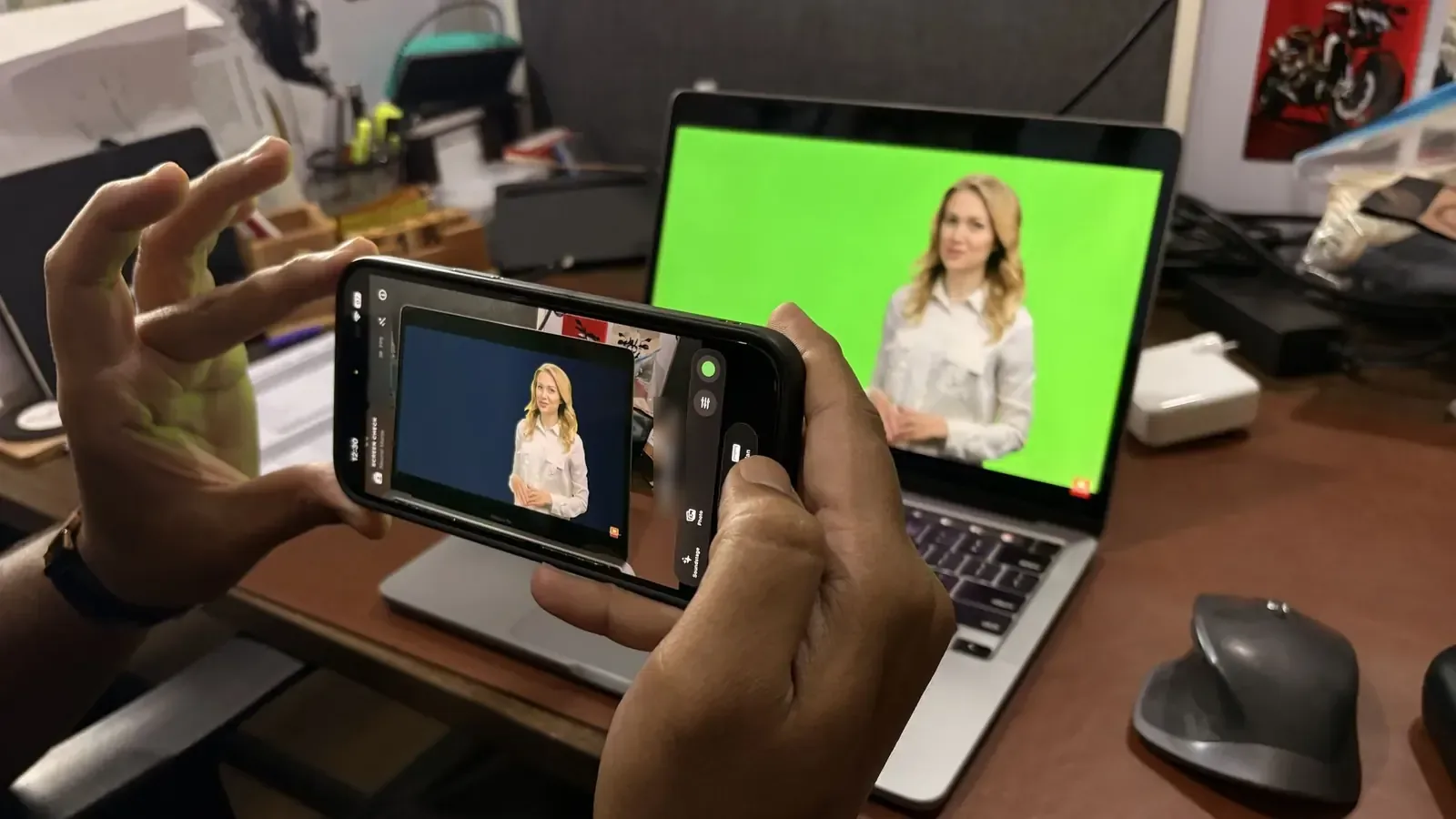
A phone running Screen Check held in front of a laptop playing green-screen footage. The phone shows the same shot already keyed onto a blue background.
Screen Check, live key preview against a test plate Working photograph, September 2026

What we make

Six tools in three pairs. Each pair shares a problem; each tool answers a different half of it.

Colour & handoff

Two halves of one job: choosing colour without leaving After Effects, and moving work between Figma and After Effects without rebuilding it. The two pass palettes to each other.

Crit Panel

After Effects CEP panel · released v1.9.0

A colour palette and harmony panel that docks inside After Effects. Pick a base colour, choose a harmony, apply the palette across selected layers, then export it as .ase or hand it to Figma. It can read the open comp and give feedback on what is actually in it.

Crit Panel in detail
  • harmoniesMono, analogous, complementary, split, triadic, tetradic
  • checksDeuteranopia, protanopia, tritanopia preview
  • exports.ase, hex list, gradient, palette to Figma
  • limitsAI features need your own API key. Saved palettes stay on that machine.
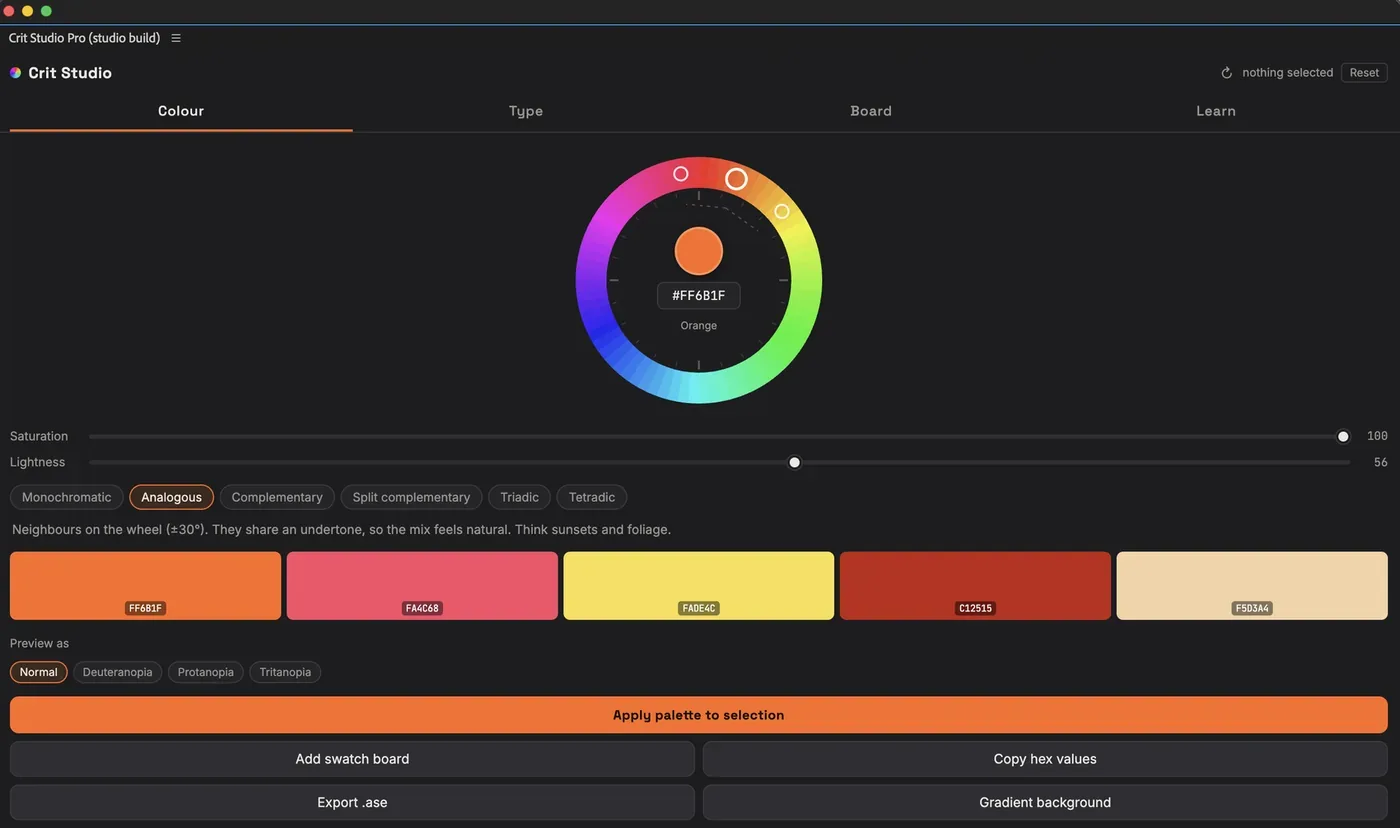
The Crit Panel window in After Effects: a colour wheel set to orange, saturation and lightness sliders, harmony options with Analogous selected, and five resulting swatches labelled with hex values.
Analogous harmony from a chosen base, with the applied swatch row
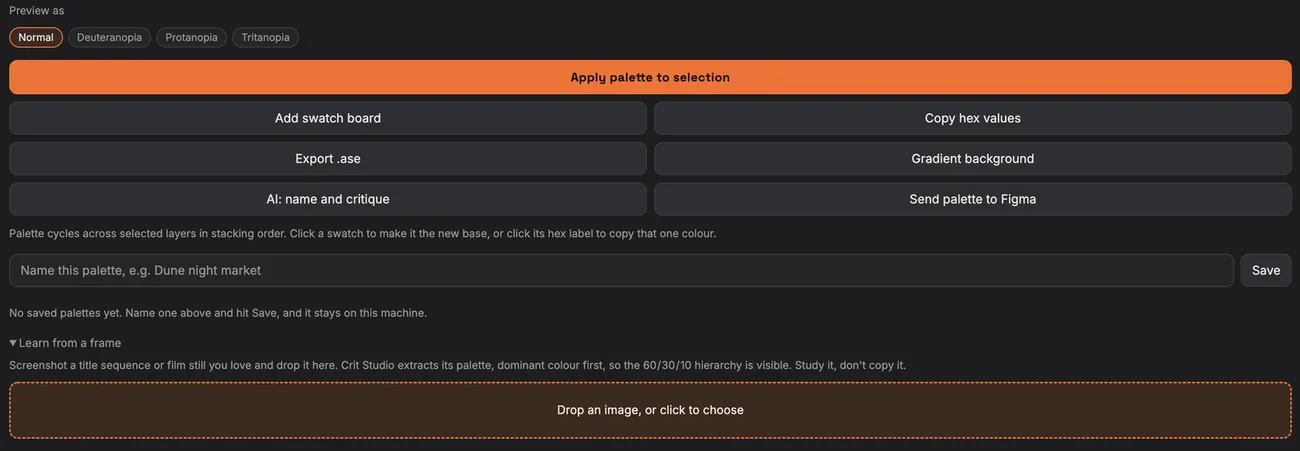
Panel actions: apply palette to selection, add swatch board, copy hex values, export .ase, gradient background, AI name and critique, send palette to Figma, and a drop zone for extracting a palette from a film still.
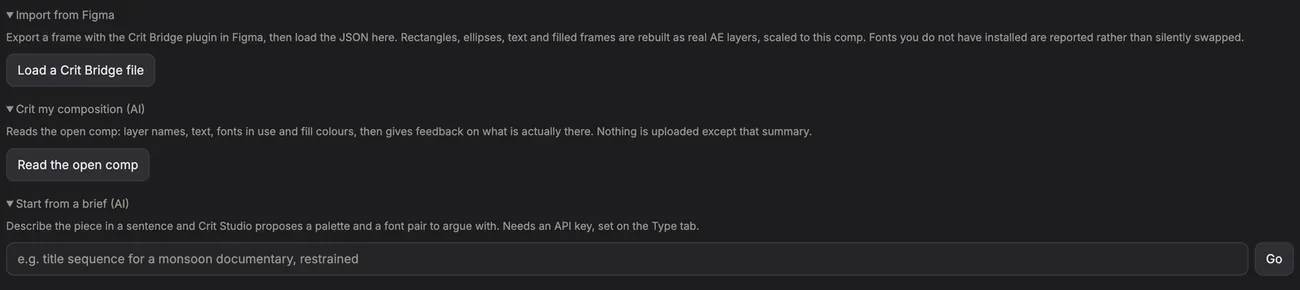
Panel sections for importing a CRIT Bridge file from Figma, reading the open composition for feedback, and starting from a written brief.

CRIT Bridge

Figma community plugin · released v1.0.1

A Figma plugin that sends frames to After Effects as editable layers. Rectangles, ellipses, text and filled frames arrive with their names, positions, colours and fonts intact. Fonts you do not have installed are reported rather than swapped silently, so you find out at import instead of at render.

CRIT Bridge in detail
  • carriesNames, positions, colours, fonts
  • both waysSend to AE; bring a palette back as paint styles
  • scopeA selected frame, or the whole page
  • limitsReturn trip is pasted JSON, not a live link.
CRIT Bridge on the Send to AE tab, with a Read selection button.
CRIT Bridge on the Bring from AE tab, with a field for pasting palette JSON exported from Crit Panel.
Both directions of the same plugin

Two builds, for these two

The panel and the plugin share a licence model. The difference is the AI layer and whose keys it runs on, not the features you get.

Student build

open · no licence key

  • Every core feature, unlocked
  • No licence key, no activation
  • Bring your own API key for the AI features
  • Coursework, portfolio and personal projects

Studio build

teams and commercial work

  • Everything in the student build
  • AI layer configured and managed for you
  • Keys handled at team level
  • Support direct from the person who built it

Applies to these two products only. Pricing for the other tools is set per product.

Teaching & learning

One app for the student learning to see colour, one platform for the person running the course. Both came out of the same classroom.

CRIT ColourStudio

iPhone and iPad · released v1.0.0, August 2026

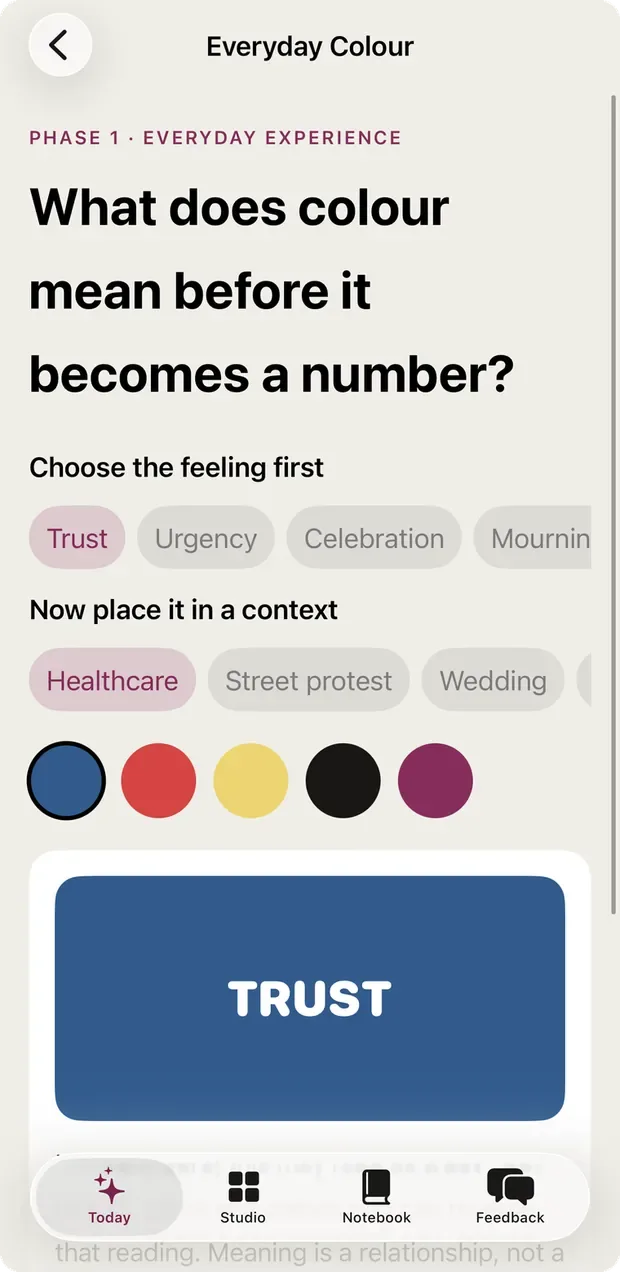
A colour theory app for iPhone and iPad. Four phases that start with something ordinary, make it fail in a useful way, then offer a better model to test. Phase one asks what a colour means before it becomes a number. Built for students who can recite colour theory and still not see it on screen.

ColourStudio in detail
  • structureFour phases, five lessons, unlocked in order
  • sessionAround 90 seconds
  • accountNot required
  • limitsColour judgement depends on your display. The app asks you to set neutral light and pause Night Shift first.
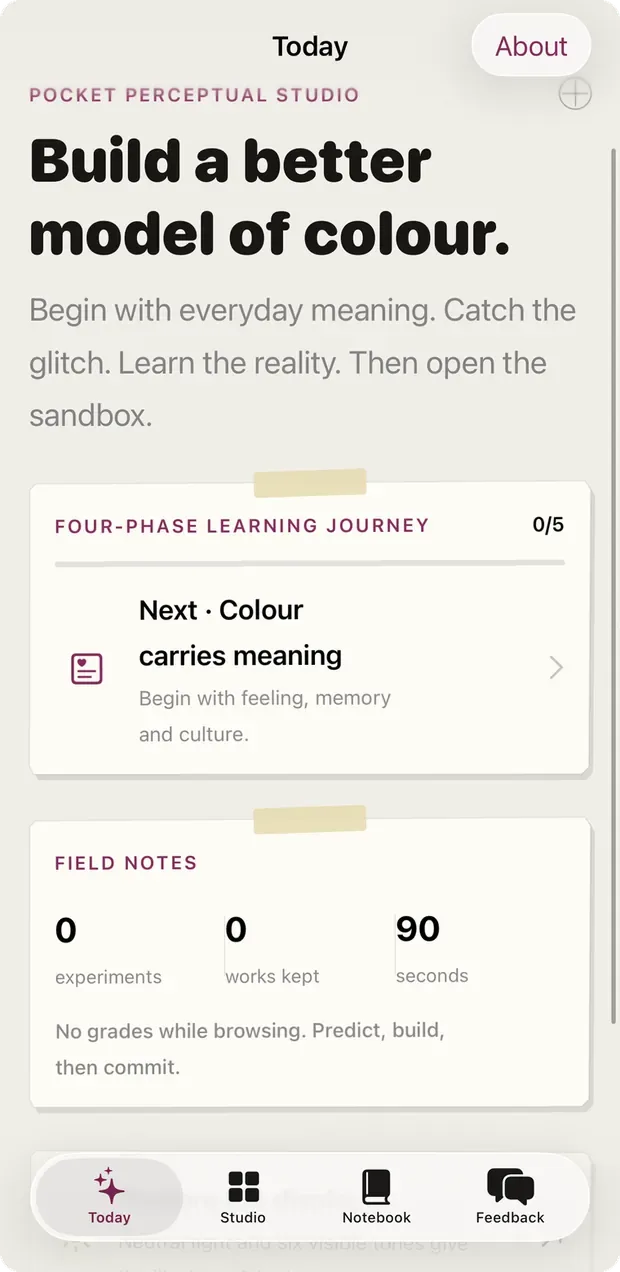
ColourStudio Today screen: build a better model of colour, with a four-phase learning journey card and field notes.
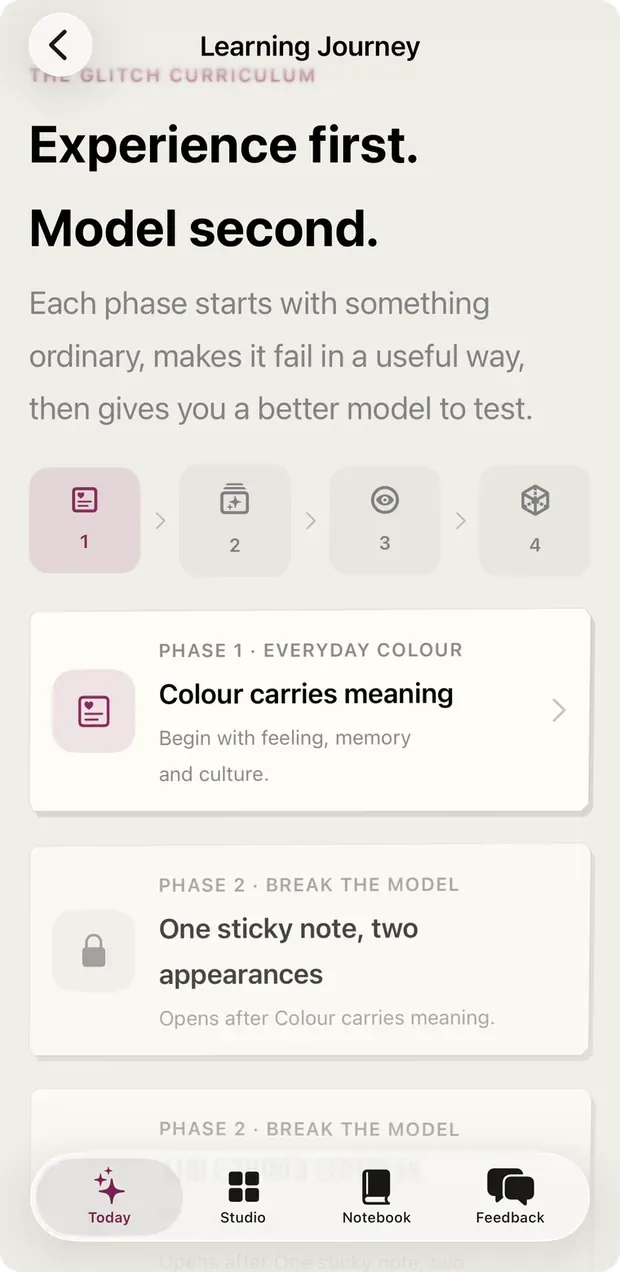
ColourStudio learning journey: experience first, model second, with four phases and the second locked until the first is finished.
A ColourStudio lesson asking what colour means before it becomes a number, with feeling and context chips and a swatch labelled Trust.

Course companion platform

Web · public name to confirm

A course website for studio teaching. Briefs, references, submissions and crit notes for a running course, in one place. Set up per course rather than per institution, so it can be in use next week without a procurement cycle.

Open the platform
  • set up perCourse, not per institution
  • holdsBriefs, references, submissions, crit notes
  • stageIn use; public name and scope still to confirm

Field instruments

Take a phone somewhere and get a straight answer about the physical situation in front of you. Both are in development, and Screen Check is described here only in outline.

Screen Check

iPhone and iPad · in development

A previsualisation and planning tool for green screen, blue screen and screen-free shoots. It answers the questions that decide whether a setup will work before the set is built, then lets you check the real thing through the camera on the day. It answers with a decision first, and the numbers behind it second.

In development, not yet released
  • two modesPlan before the shoot, check through the camera on the day
  • devicesiPhone and iPad
  • stageIn development. No release date, no listing yet.
  • detailDeliberately withheld while the work is unpublished. This page describes the problem it addresses, not how it addresses it.

Bearing

iPhone · in development

A field capture camera for site and evidence work, built for photographs that have to hold up later. The shutter waits for a fresh GPS fix rather than a remembered one, the stamp burned into the image stays readable, and every saved capture is sealed on the device. An existing photograph can be imported and sealed without altering the original. For solo professionals and small teams, not a novelty watermark camera.

In development, not yet released
  • principlesLocation is a measurement, the stamp is readable, every capture is sealed
  • shutterWaits for a fresh fix; horizontal accuracy always shown, never a cached reading
  • stampMinimal, Standard or Survey density; coordinates stay authoritative when an address will not resolve
  • policyFree, no ads, no account, no analytics, no watermark of ours
  • limitsLocal tamper evidence, not a public credential. Not C2PA certified, and it does not claim that GPS cannot be spoofed.
Open items. Specifications on this page were read from build screens dated 05 September 2026. Screen Check and Bearing are in development: neither has a release date, a listing or a support route yet, and nothing said about them here is a claim of availability. The course companion platform needs a public name and scope.

How we work

Start with a recurring difficulty. Make a response someone can try. Learn from what happens next.

Observe

Watch a recent real task. Record the workaround people rely on and what it costs them.

Frame

Name the competing causes, then choose the single most important uncertainty.

Test

Run the smallest credible test, with continue, change and stop conditions set in advance.

Decide

Continue, narrow, change or stop on the evidence. Publish what was learned, limits included.

Practitioner frustration gives us a hypothesis. Observation with other people tests it. Where information is incomplete or unverified, this site says so rather than rounding it up into a claim.

About

One studio, run out of a classroom.

Some problems become so familiar that people stop questioning them. CRIT Studio pays attention to those moments. We ask what is getting in the way, make a response people can try, and stay close enough to learn what needs to change.

Our work can become an app, a plugin, a resource, a service or a better workflow. AI helps us explore and build. Observing real use helps us decide what deserves to continue.

The studio is run by Kamalanarayanan Kamalakannan, who spent around eleven years as a VFX compositor on international features before moving into teaching, and now runs the Communication Design programme at Woxsen University's School of Arts & Design in Hyderabad.

If a tool cannot survive thirty students using it badly in week one, it isn't finished. Working principle at CRIT Studio

What keeps getting in your way?

Tell us about a task you repeat, or a workaround you have stopped noticing you rely on. Something as ordinary as rebuilding the same lower third six times a week is exactly the kind of thing worth hearing about.

start here
hello@critstudios.com